The Cap





The H-1B nonimmigrant category allows U.S. employers to hire highly skilled temporary workers from abroad. However, there is a fixed number of H-1B spaces available every year, and this quota, or cap, has tended to be exhausted very quickly. In the past several years, in fact, the cap has been met within several business days after H-1B filing season began.
What is the H-1B cap?
Authorized statutorily by Congress, the H-1B cap sets a limit on the number of these visas that U.S. Citizenship and Immigration Services (USCIS) can issue to foreign workers every fiscal year. (A fiscal year runs from October 1 of one year to September 30 of the following year.)
There are actually two quotas encompassed in the H-1B cap: the regular cap comprising beneficiaries with bachelor’s degrees, and the “master’s cap,” which is reserved for beneficiaries with at least a master’s degree from a U.S. school. The numerical limit for regular H-1B petitions is 65,000 visas annually, while the master’s cap reserves an additional 20,000 H-1B visas per year.
Within the regular cap, a maximum of 6,800 visas is set aside for beneficiaries eligible for a subtype of the H-1B visa, the H-1B1. This subcategory is reserved for alien workers from Chile and Singapore, as stipulated in free trade agreements between the U.S. and those countries. Any unused H-1B1 visas are factored back into the regular cap.
Brief History of the Cap
The H-1B cap dates back nearly three decades. Under the Immigration Act of 1990, Congress first imposed the 65,000 annual quota for each fiscal year. While the first imposition of the cap occurred during fiscal year 1992, the cap was completely exhausted for the first time five years later, in fiscal year 1997.
For a brief period, after passage of the American Competitiveness and Workforce Improvement Act of 1998 (ACWIA), the cap was nearly doubled from 65,000 visas to 115,000 from 1999 to 2000. The underlying reason Congress used to justify the expansion was meeting the growing labor needs of U.S. employers. The temporary increase wasn’t sufficient, apparently, as the cap was increased again to 195,000 visas after Congress passed the American Competitiveness in the 21st Century Act (AC21) in October 2000. The quota remained at this level until 2003. In light of the increases, during these few years in the 1990s and 2000s, the fear about “running out” of H-1B spaces was effectively nonexistent.
That fear emerged beginning in fiscal year 2005, however, as the H-1B cap was brought back down to 65,000. During this year, the H-1B cap was reached on October 1, 2004, i.e. the very first day of fiscal year 2005, based on petitions that had been filed between April 1 and October 1. By the subsequent year, the cap was exhausted a month earlier.
Frustration over H-1B cap exhaustion continued to intensify when USCIS announced on June 1, 2006, that it had received so many H-1B petitions as of May 26, it would reject any cap-subject H-1B petitions received after that date. According to Deborah J. Notkin, president of the American Immigration Lawyers Association (AILA) at the time, the announcement was “unprecedented,” marking “the second year in a row that the H-1B cap has been prematurely reached.” The trend would become standard from then on.
Limited Supply, High Demand
Over the past several years, the H-1B visa has solidified its place in the U.S. immigration system as one of the nonimmigrant channels most favored by petitioning employers and foreign workers alike. As a result, there has tended to be a large discrepancy between the number of H-1B petitions filed every year and the number of H-1B visas available to be doled out.
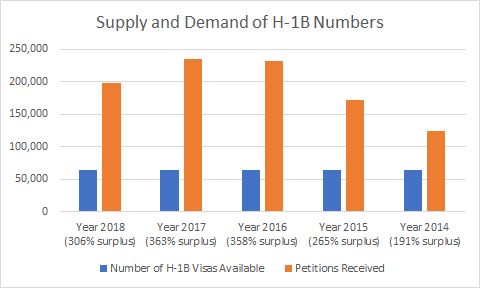
To underline the supply-and-demand discrepancy, consider the graph below, which shows the past five years of H-1B application numbers.
 |
| Source: USCIS |
H-1Bs that are awarded for a given fiscal year may be used by alien beneficiaries no earlier than the first day of said fiscal year, i.e. October 1. As such, October 1 is the earliest day an H-1B beneficiary can begin working in his or her “specialty” occupation position.
Further, the earliest one can apply for an H-1B is six months before the associated job is slated to begin. Accordingly, if an alien worker is scheduled to start working on the first possible day (October 1), the alien’s petitioning employer should submit the H-1B application on April 1 (or, if April 1 falls on a weekend, the next business day).
Implications of the Cap
Because H-1Bs run out so quickly, employers tend to schedule their H-1B workers to start as early in the fiscal year as possible: on or as soon after October 1 as possible. This means that they submit applications a full six months earlier: on or as soon after April 1 as possible. As a result, USCIS receives an inundation of H-1B petitions every first few days of April. In fact, delivery truck after delivery truck, all of them filled to the brim with H-1B applications, arrive at USCIS service centers within this small window of time; for more information, see this New York Times article. Most recently, for fiscal year 2018, USCIS received 199,000 applications for only 85,000 total available H-1Bs within five business days after filing season commenced.
Out of all the H-1B applications submitted, the lucky 65,000 regular and 20,000 master’s cap petitions are selected for adjudication by a random computer lottery. The tens of thousands of unselected applications are returned to petitioners unopened, along with filing fees.
Given the rush to submit applications within a very small window of time, the smallest mistake may cause USCIS to return your application, and during the intervening time, the cap will in all likelihood be exhausted. In such a situation, you’d have to wait until the next year before new H-1Bs become available. For this reason, it is essential that you entrust your H-1B application to careful, thorough, and experienced attorneys. At Zhang & Associates, we give your application multiple rounds of review and guarantee that your application arrives at USCIS by the deadline. Contact us to find out more about your H-1B options.
In light of the compressed time frame and how quickly the cap has tended to be exhausted, petitioning employers should strive to start and finalize their applications well in advance of filing season. This means that employers (or their HR professionals) should expedite recruitment and file their Labor Condition Applications (LCAs) with the U.S. Department of Labor (DOL) as soon as possible. If employers find themselves running up against the clock given the limited time available, then they should consider whether or not it’s prudent to delay the start date of the position proposed for their prospective alien employee.
Exemptions from the Cap
Under the American Competitiveness in the Twenty-First Century Act (or AC21, which you can view in full here) and other legislation passed by Congress, certain categories of employers and alien workers are exempted from the H-1B cap. The following three scenarios describe situations to which the cap isn’t applicable.
-
H-1B beneficiaries who were already subject to the H-1B quota any time within the past six years and who have not exhausted their full six years of H-1B status (unless they are eligible for a new H-1B status at the time the petition is filed)
-
H-1B physicians who have received a Conrad 30 waiver of the two-year home-residency requirement for J-1 visa holders based on work in a health professional shortage area
-
H-1B beneficiaries sponsored by institutions of higher education or related or affiliated nonprofit entities, or by nonprofit research organizations or governmental research organizations
For aliens currently in H-1B status, newly filed petitions are likewise not subject to the H-1B cap in the following situations:
-
Six Year Window: Any current H-1B holder who has been subject to the cap within the previous six years will not be subject to the cap when filing any new H-1B petitions.
-
Transfer: A worker currently in H-1B status can stop working for his or her original H-1B sponsor and begin working for a new employer. However, the new employer must file a new H-1B petition on the employee’s behalf. Fortunately, this new petition will not be subject to the cap, so the employee can begin work on the day USCIS receives the petition.
-
Extension Petitions: If the H-1B beneficiary’s current status is about to expire and he or she needs an extension for additional time (typically for another three years), the employer must file an H-1B “extension” petition.
-
Amended Petitions: If a “material change” has occurred in the terms and conditions of the employment of the alien employee, the employer is required to file an “amended” petition.
-
Concurrent Employment: If the H-1B worker wants to work for a new Employer B while also working for his original Employer A, and if the alien was subject to the cap in the past six years to receive his original H-1B status, then Employer B can file a “concurrent” H-1B petition on his behalf. However, if Employer A was cap-exempt and Employer B is not, then the petition from Employer B will be subject to the cap.
From Cap-Exempt to Cap-Subject Employers
What if an H-1B worker was never subject to the cap because she worked for a cap-exempt employer but now wants to change jobs and start working for a cap-subject employer? In such a common occurrence, she has a viable path forward.
When H-1Bs become available again (i.e. when the cap is replenished for the subsequent fiscal year, beginning in April), she can switch from a cap-exempt employer to a cap-subject employer by virtue of the portability rule. However, it is important to note that if her H-1B transfer petition is approved before October 1 (i.e. the start of the next fiscal year), the employee should stop working for her new employer at the time of approval and wait until October 1 to begin working in the approved H-1B position. If the H-1B cap has been met for the fiscal year and an employee of a cap-exempt H-1B petitioner wishes to transfer to a cap-subject employer utilizing the portability rule to start working immediately for the new employer, the transfer petition could be viewed as frivolous and thereafter be denied. USCIS has made it clear that it will only approve an H-1B petition filed under these circumstances if the beneficiary does not end employment by the cap-exempt petitioner. (For more information about this, see the following USCIS memorandum: Supplemental Guidance Relating to Processing Forms I-140 Employment-Based Immigrant Petitions and I-129 H-1B Petitions, and Form I-485 Adjustment Applications.)
Let’s consider the implications of the above situation through a credible case study.
Background
Pablo is a researcher in H-1B status at the University of Hooyou, which is a cap-exempt employer. Pablo has recently found a new job with a private company, and this prospective employer would like to petition for an H-1B visa for Pablo.
Analysis
Given that the University of Hooyou is exempted from the H-1B cap as an institution of higher learning, Pablo was not subject to the quota when he originally applied for H-1B status. Accordingly, if the current H-1B quota has been met, he is ineligible to port his H-1B status to the new private-sector employer. If the quota has not been met and there are still H-1B spaces available, then he is able to use the portability rule to transfer to the new private-sector employer and begin working for it after USCIS receives the transfer petition *counted among quota*. However, Pablo and his new employer should be aware that if his transfer petition is approved before October 1, he should cease working for the new employer at the time of approval and only resume work after October 1. It is important to note that the receipt notice will be issued either when the petition is selected in quota or when it is filed when the quota hasn't been exhausted.
Coping Strategies for Alien Workers
For an alien worker expecting to work in the U.S. under an H-1B, there is little more frustrating than receiving a job offer from a U.S. employer after the quota has already been met. As a legal services provider, we sympathize with alien workers who experience hardship because of this. The following strategies are general suggestions for coping with this situation, although individual cases may require different approaches:
- Certain individuals who are in F-1 status can use OPT to their advantage to help them cope with the H-1B cap. Let us explain. It is common for employers to hire recent graduates who studied in the U.S. on F-1 student visas and apply for H-1B visas on their behalf. F-1 holders are granted a certain period of “optional practical training,” or OPT.
OPT generally allows a student to work in her field of study for a period of twelve months, followed by a two-month grace period during which she is permitted to remain in the U.S. legally. Thus, assuming an alien’s OPT starts in August 2017, then she is able to work until August 2018, and the subsequent two-month grace period would allow her to bridge the gap until October 2018, by which point her H-1B petition is, hopefully, approved.
However, the Department of Homeland Security recently issued a final rule allowing F-1 students studying in a science, technology, engineering, or mathematics (STEM) field to extend their post-completion OPT period by 24-months. Thus, STEM students in F-1 status have extra time available to work in the U.S. if they aren’t successful in obtaining an H-1B.
-
Certain individuals who are in F-1 status can use OPT to their advantage to help them cope with the H-1B cap. Let us explain. It is common for employers to hire recent graduates who studied in the U.S. on F-1 student visas and apply for H-1B visas on their behalf. F-1 holders are granted a certain period of “optional practical training,” or OPT.
OPT generally allows a student to work in her field of study for a period of twelve months, followed by a two-month grace period during which she is permitted to remain in the U.S. legally. Thus, assuming an alien’s OPT starts in August 2017, then she is able to work until August 2018, and the subsequent two-month grace period would allow her to bridge the gap until October 2018, by which point her H-1B petition is, hopefully, approved.
However, the Department of Homeland Security recently issued a final rule allowing F-1 students studying in a science, technology, engineering, or mathematics (STEM) field to extend their post-completion OPT period by 24-months. Thus, STEM students in F-1 status have extra time available to work in the U.S. if they aren’t successful in obtaining an H-1B. -
Students with an F-1 visa are also eligible for curricular practical training (CPT). CPT allows students to work in a job related to their field of study while they are still studying. Thus, if an H-1B hopeful is offered a job by a U.S. employer but is unsuccessful in the H-1B cap, one option is to obtain F-1 status to return to school and work for the employer using CPT, as long as the job is related to the student’s field of study. This will give them the opportunity to work while waiting for the H-1B cap to refill in subsequent years.
-
A third option for H-1B hopefuls frustrated by the cap is to apply for O-1 status. The O-1 is a temporary employment based status reserved for individuals who possess “extraordinary ability” in the sciences, arts, education, business, or athletics. While this status is limited to three years, it does have some advantages over the H-1B for some individuals, which you can read about here.
-
Another potential strategy for aliens whose H-1B petitions were not selected or approved is to change from OPT status to status under an Employment Authorization Document (EAD). Applications for permanent residency are not based on H-1B status. Some green card applications, such as EB-1A and National Interest Waivers (NIW), do not require an employer’s sponsorship. And so if an alien’s Form I-140 petition is approved on time and visa numbers are available to him, then the alien can can submit a Form I-485 petition along with an EAD application. The processing timeline for an EAD is comparatively faster, making it possible to obtain a valid EAD by the time one’s OPT expires.
Frequently Asked Questions about the H-1B Cap
Q: What is the H-1B cap?
A: The H-1B cap is a limit set by Congress on the number of H-1B visas granted annually. This cap applies to workers admitted to the United States as H-1B visa holders and to people changing their status to H-1B from another status (e.g., B-1, F-1, J-1, etc.).
Q: What is the cap currently set at?
A: Currently, the cap is set at 65,000 H-1B visas per year. Of these, 6,800 are reserved for citizens of Chile and Singapore under free trade agreements. An additional 20,000 H-1B visas are set aside for aliens with U.S.-earned master’s degrees or higher.
Q: What happens to unused spots reserved for citizens of Chile and Singapore?
A: These visas are knowns as H-1B1 visas. Any unused H-1B1 visas for a particular fiscal year are to be made available to all H-1B applicants within the first 45 days of the next fiscal year.
Q: If I hold an advanced degree from the U.S., does this mean I have to petition for one of the 20,000 master’s cap spaces?
A: No, you may try to apply for the regular cap first if it is available.
Q: Who is exempted from the H-1B cap?
A: The following H-1B applications are not subject to the cap:
-
Applications for extensions of H-1B status,
-
H-1B petitions for concurrent employment when the alien worker is presently in H-1B status that was subject to the cap,
-
H-1B petitions to change employers when the alien was already subject to the quota in the past six years,
-
H-1B applications sponsored by institutions of higher education (or a related or affiliated nonprofit entity), or government or nonprofit research organizations, and
-
H-1B applications for physicians who received J waivers under a Conrad 30 waiver.
Q: How soon can my prospective employer file an H-1B petition for me after a job offer is extended?
A: The earliest an employer can file an H-1B petition is six months prior to the employment date indicated in the petition.
Q: When does a fiscal year begin?
A: Fiscal years begin on October 1.
Q: In recent years, how soon has the cap been reached?
A: For fiscal year 2018, the cap was reached on April 7, 2017. Scroll up to the table above for more information on cap exhaustion over the past few years.
Q: What can I do if my petition is rejected due to cap limitations?
A: There are a few options available to those who have been rejected because the cap was reached:
- Optional Practical Training (OPT) is another viable option if you hold a valid F-1 visa.
-OPT allows a student to work in his field of study for a period of 12 months, followed by a two-month grace period during which he can remain in the U.S. legally. Therefore, if an alien’s OPT starts August 2017, he can work until August 2018, and the two-month grace period will allow him to bridge the gap and be eligible for H-1Bs for fiscal year 2019.
-Keep in mind that F-1 students studying a STEM subject (science, technology, engineering, math) are eligible for a 24-month extension of OPT, which affords them more time to wrestle with the H-1B cap.
-
Go back to school and work for your employer using curricular practical training, or CPT, which allows students to work in a job related to their field of study. This option will also offer more time to find success with the H-1B cap.
-
Another potential strategy is to change from OPT status to status under an Employment Authorization Document (EAD), altogether forgoing an H-1B visa.
-
Aliens and their employers should also check to see if they are exempted from the H-1B cap based on any of the following:
-Applying to extend a current H-1B
- A foreign worker can work for different employers simultaneously with different H-1B visas. If an employer petitions for a foreign worker whose first H-1B visa was counted against the quota, the second petition is exempt from the cap.
- If a foreign worker wants to change her employer, and her previous H-1B was subject to the cap, the new petition is exempt.
- If a beneficiary was counted against the quota within the past six years and has not been outside of the U.S. for more than one year during the past six years, the alien’s new H-1B petition is exempted.
-
If none of the options above applies to your situation, you’ll have to change or extend your existing non-worker status. For instance, you may want to enroll in another academic program to keep your F-1 status, or change to some other status based on, say, your spouse's legal status.
-
To be re-admitted for the “remainder” of the initial six-year admission period without being subject to the H-1B cap if previously counted; or
-
To seek to be admitted as a “new” H-1B alien subject to the H-1B cap.
-Applying for concurrent H-1B employment
-Applying for a change in employment
-Applying to work for a cap-exempt employer
-Applying to work as a physician who has received a J waiver under the Conrad 30 program
-Accounting for time
Q: How is the premium processing service affected by the cap?
A: Premium processing cases filed before the date that the cap is reached will be processed with premium processing, i.e. within 15 days of USCIS’ receipt of the application Premium processing has no effect on the cap itself.
Q: I am in H-1B status now and would like to change jobs. Is the new H-1B petition for me subject to the H-1B quota cap?
A: Not necessarily. If you were subject to the H-1B quota in the past six years and worked for the H-1B employer in H-1B status, your new H-1B will not be subject to it again. If you change your job to an H-1B cap-exempt organization, the new H-1B is similarly not subject to the cap. However, if you were not subject to the H-1B quota in the past six years but now want to work for a cap-subject employer, the new H-1B will be subject to the cap.
Q: I am currently working for one company in H-1B status, and I wish to work for another company concurrently. Will I be subject to the cap restrictions?
A: No. As long as one is in H-1B status, petitions to work for another employer concurrently are not subject to the cap.
Q: I was in H-1B status but am now in F-1 (student) status. I’d like to apply for H-1B status. Will my new H-1B petition be subject to the cap?
A: If your previous H-1B was subject to the cap within the past six years, you will not be subject to the cap. However, if you have been out of the U.S. for more than one year and your previous H-1B status did not exceed six years, USCIS allows you either:
In either case, the U.S. employer needs to file an H-1B petition and get USCIS approval first.
For more detailed information on the H-1B category, including minimum requirements and USCIS policies, refer to the following links:
Updated 05/08/2017